
Case study
Capital One Café
Retail architectural visualization supporting executive approvals for flagship Capital One Café locations across Manhattan.
Project at a glance
Retail architectural visualization built to win executive-level approvals across flagship Capital One Café locations in Manhattan.
- Client
- O'Neil Langan Architects
- End client
- Capital One Café
- Building type
- Retail bank-café hybrid
- Location
- Manhattan, New York
- Sites
- Herald Square (53 W 34th St), Union Square (853 Broadway), Columbus Circle (1843 Broadway)
- Purpose
- Executive-level design approvals
- Scope
- 15 interior views, 8 exterior views
- Timeline
- Set to the approval milestones
- Outcome
- All three cafés built and open across Manhattan
The brief
A Visualization Extension of the Design Team.
O'Neil Langan Architects (OLA) is one of New York's leading architecture firms, specializing in high-end retail, hospitality, corporate interiors, and brand-driven environments. Founded in 1996, the firm pairs creative, detail-oriented design with precise execution and strong project management, carried by a multidisciplinary team of more than fifty architects, interior designers, CAD specialists, and brand strategists. Their portfolio spans global retail rollouts, flagship stores, showrooms, and commercial architecture for established and emerging brands alike.
OLA was designing several new Capital One Café locations in some of Manhattan's busiest and most recognizable districts: Union Square, Herald Square, and Columbus Circle. Their objective was to secure clear, timely approvals from Capital One's leadership team, which meant the visuals had to communicate design intent to non-technical stakeholders, reflect the real urban context with precision, adapt quickly to evolving design details, and keep pace with tight internal review timelines.
The challenge was not purely visual quality. It was accuracy and responsiveness under real commercial pressure. NoTriangle's role was to act as a reliable visualization extension of OLA's design team, helping them move the projects through approval efficiently while maintaining design integrity.
The challenge
Non-Negotiable Milestones on Prime Manhattan Corners.
Capital One's approval milestones were fixed, and each café sits in a highly visible retail environment where contextual accuracy directly shapes stakeholder confidence. Four pressures defined the work:
- 01Fixed, non-negotiable approval milestones, demanding steady iteration and ongoing design updates without rework.
- 02High-fidelity urban context in prime NYC locations: surrounding buildings and scale, realistic street proportions, pedestrian flow, and authentic atmosphere.
- 03Elevating early-stage PDFs that lacked presentation impact into views suitable for executive-level review.
- 04A scope that expanded mid-stream, from a single café to 15 interior and 8 exterior views across three locations, inside a fixed approval schedule.
The expanded program came with structured schedules, reference deadlines, and staged review cycles. It required a workflow capable of scaling without sacrificing quality or control.
The approach
Coordination First, Cameras Second.
We began with a full working session with OLA's project management team, aligning early on the objectives, approval milestones, timelines, scope per location, file handoff standards, feedback and revision cycles, and internal approval checkpoints. OLA supplied Revit models, FF&E references, and an initial program test-fit, which we treated as a living framework, refining it iteratively as design decisions evolved. That early coordination eliminated ambiguity and created a predictable production rhythm from day one.
OLA had preselected viewpoints, but we ran a focused camera exploration phase to test alternative compositions anyway. The reasoning is intentional: clearer views lead to clearer understanding, and more confident approvals. We presented multiple camera options, explained the rationale behind each, and recommended the strongest set for Capital One's internal reviews before finalizing the presentation angles.
In the views
A Café an Executive Could Judge at a Glance.
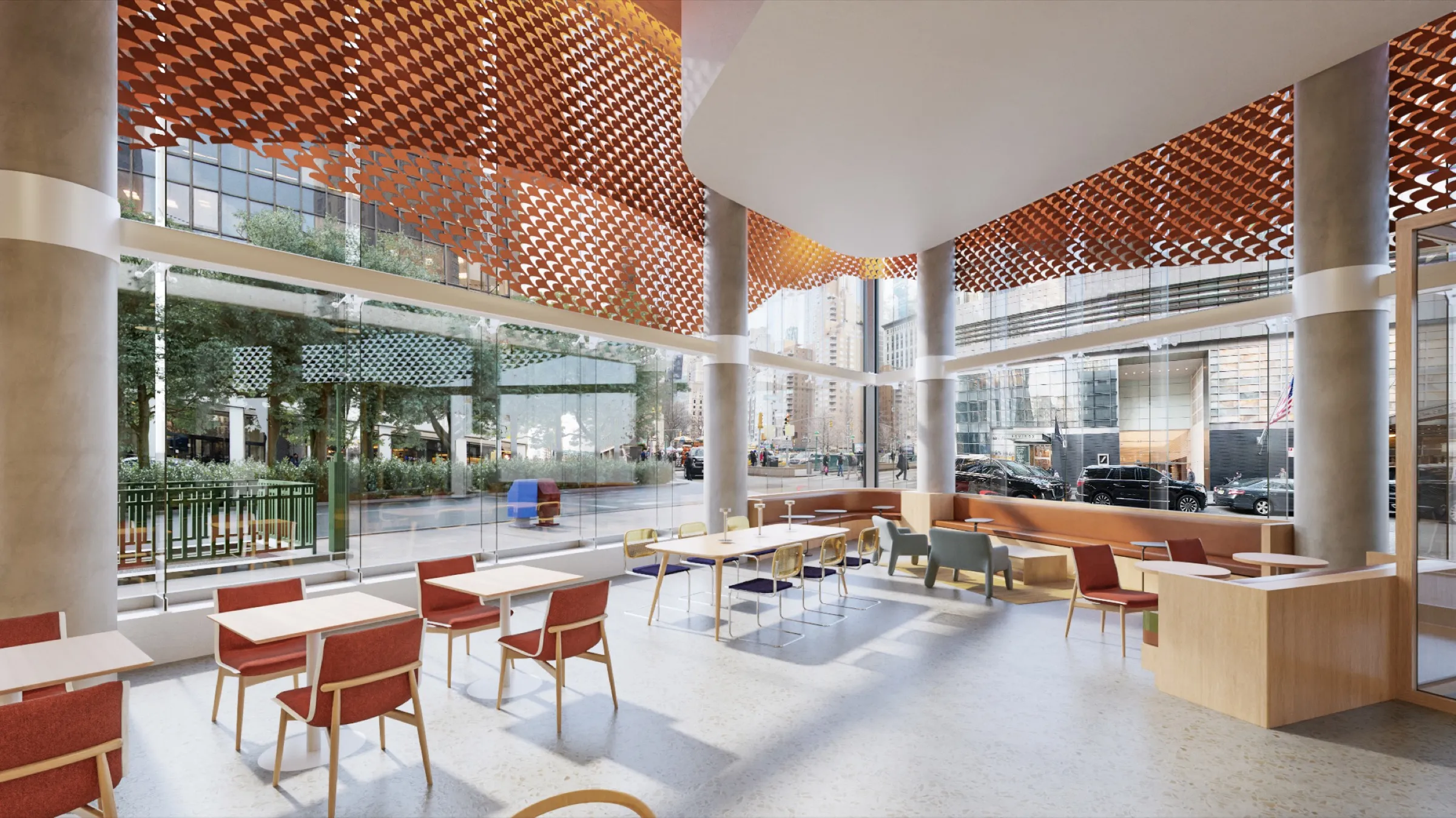
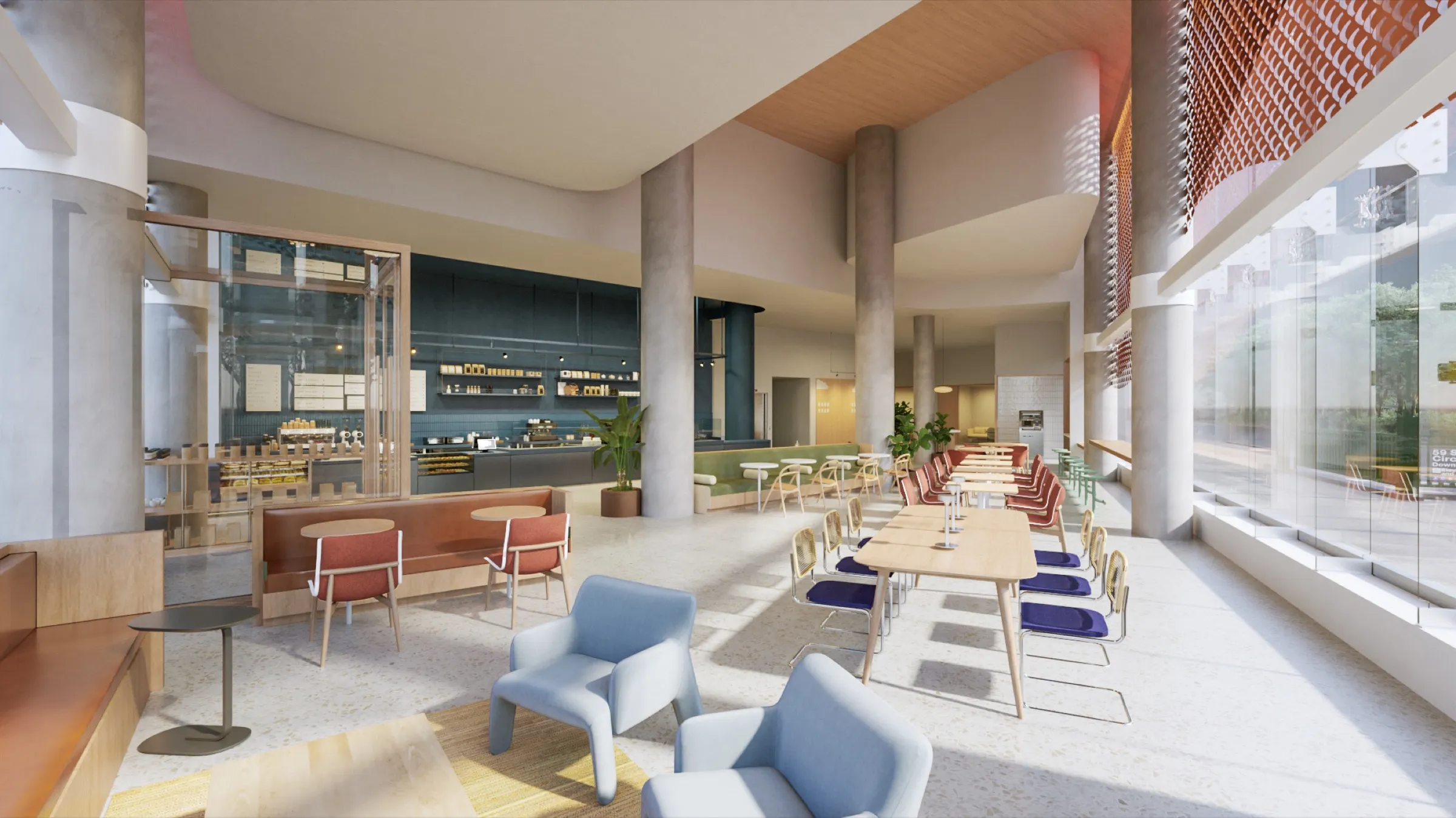
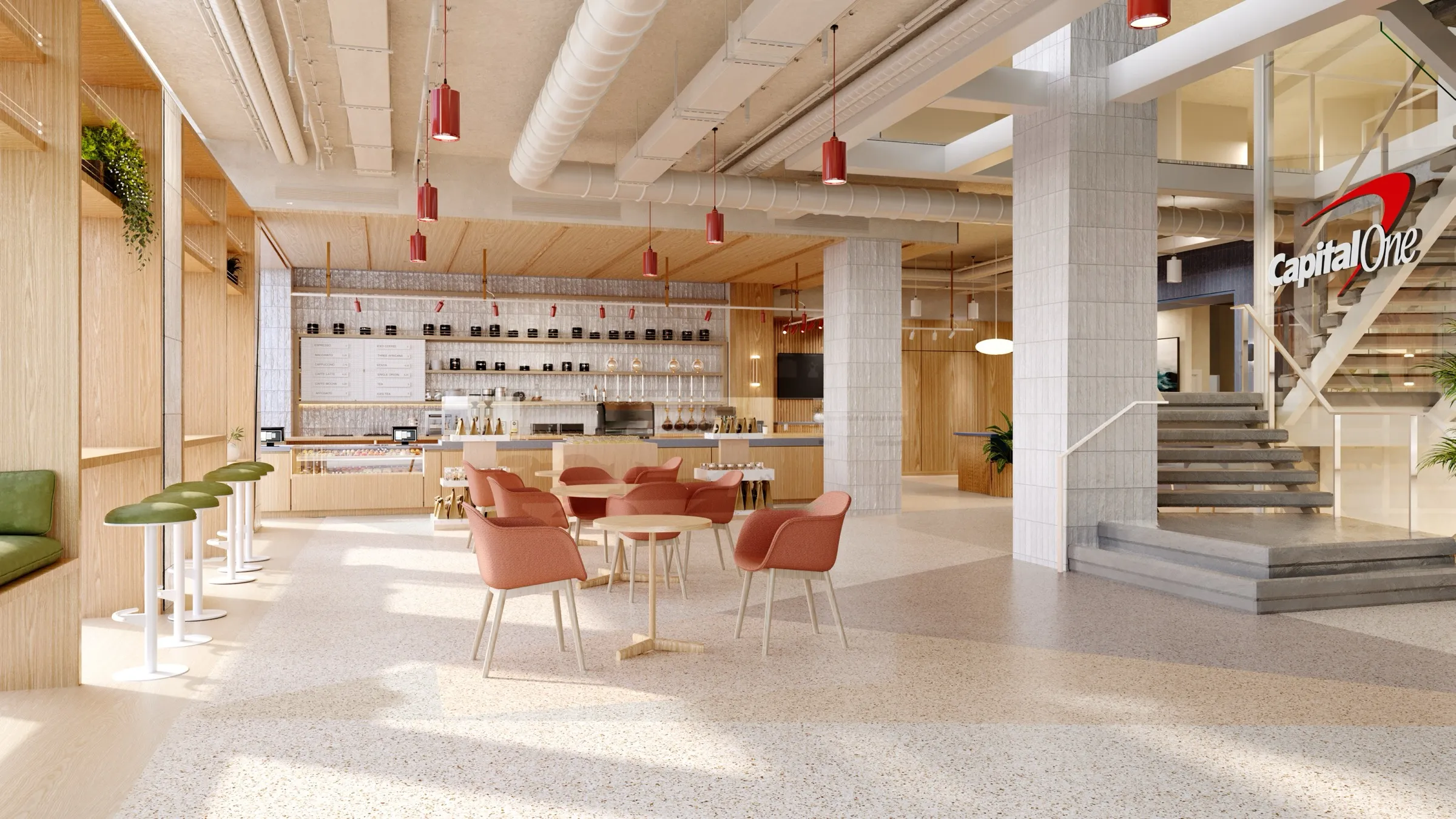
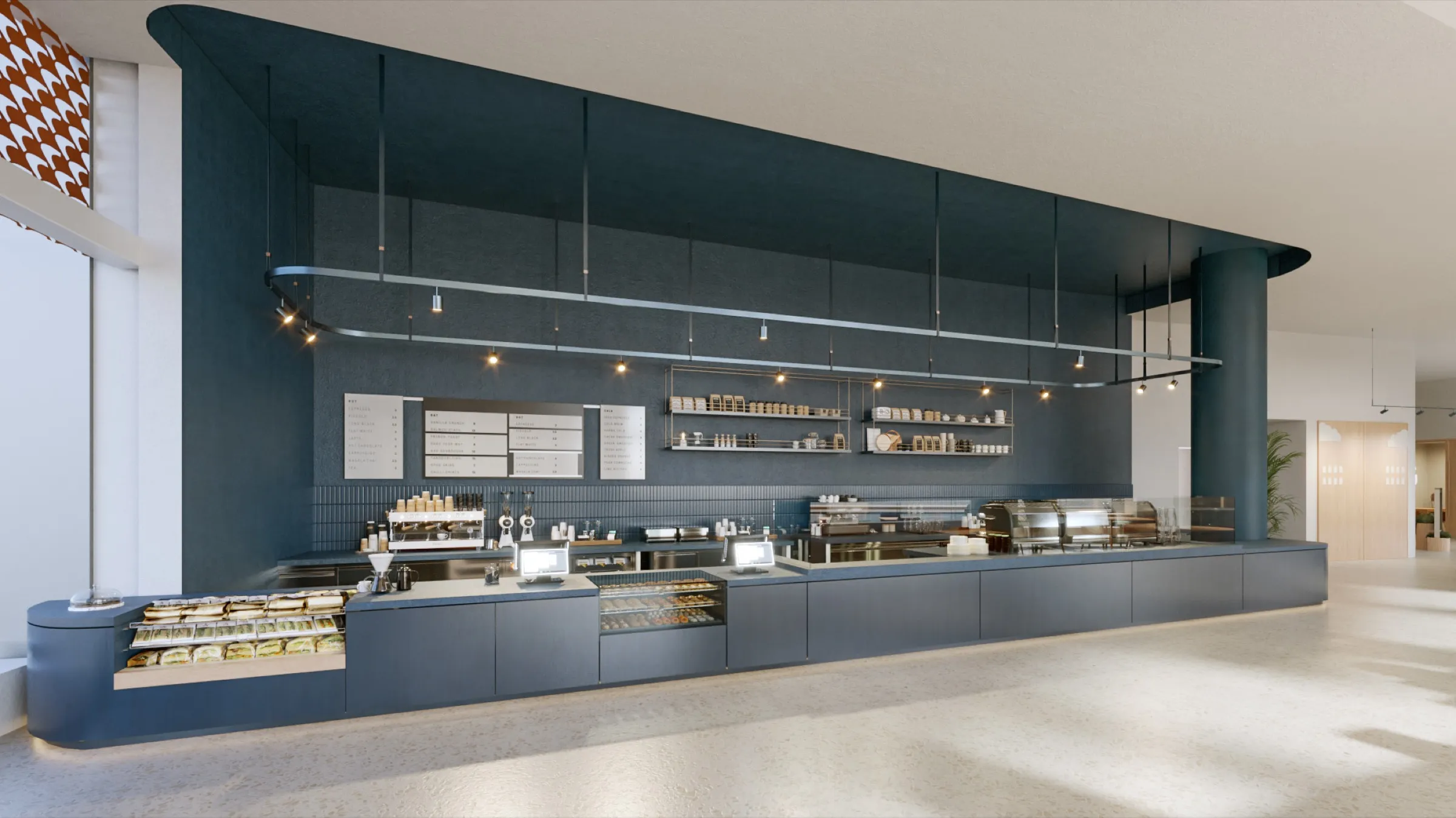
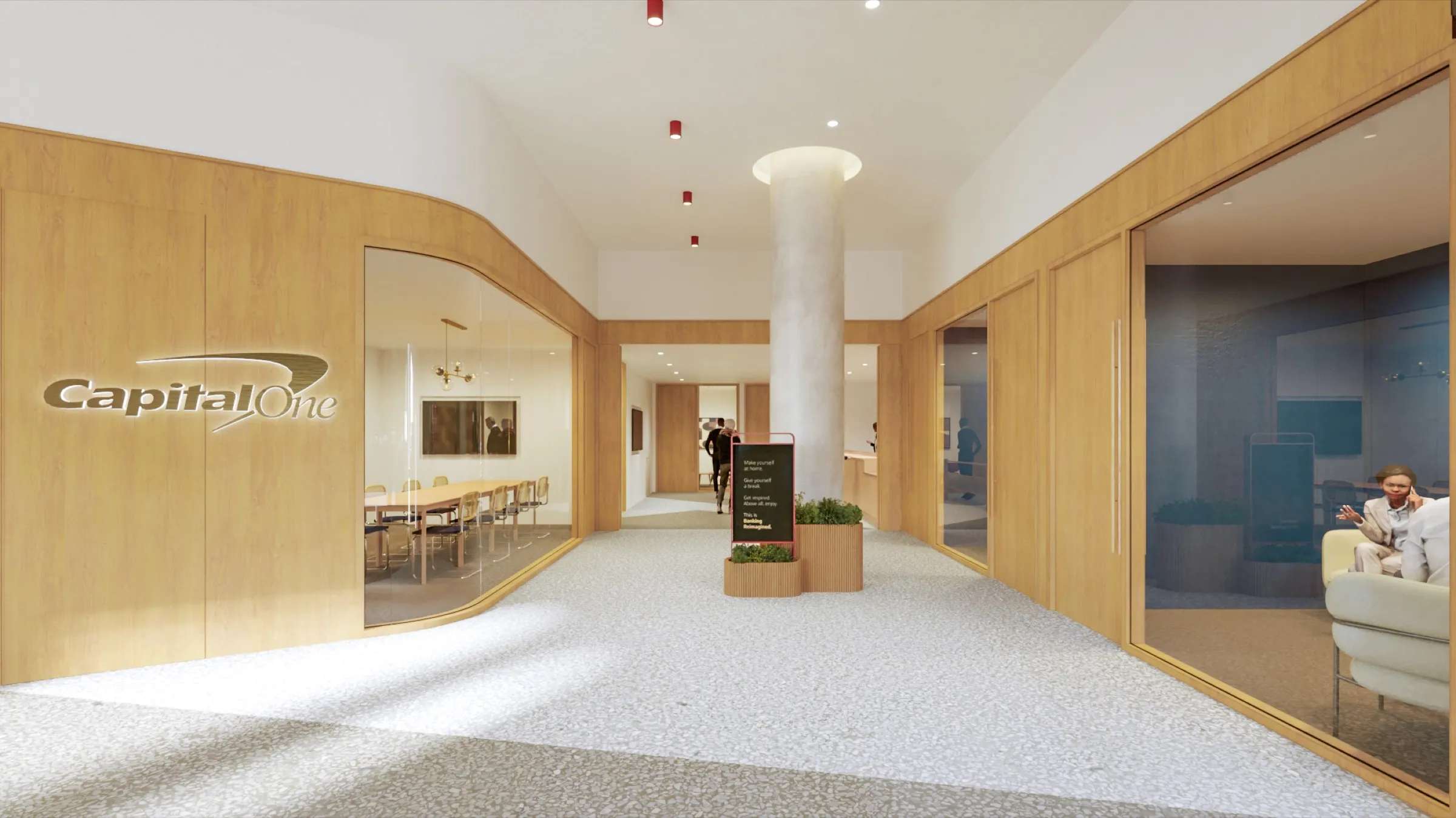
The Union Square café, its coffee bar lit by red pendants and the brand carried up the staircase, shows what the approval views were built to do: put a non-technical decision-maker inside the finished space, with the materials, branding, and retail atmosphere already in place, so a yes did not require reading a drawing.
The production
Real Streets, Matched in 3D.
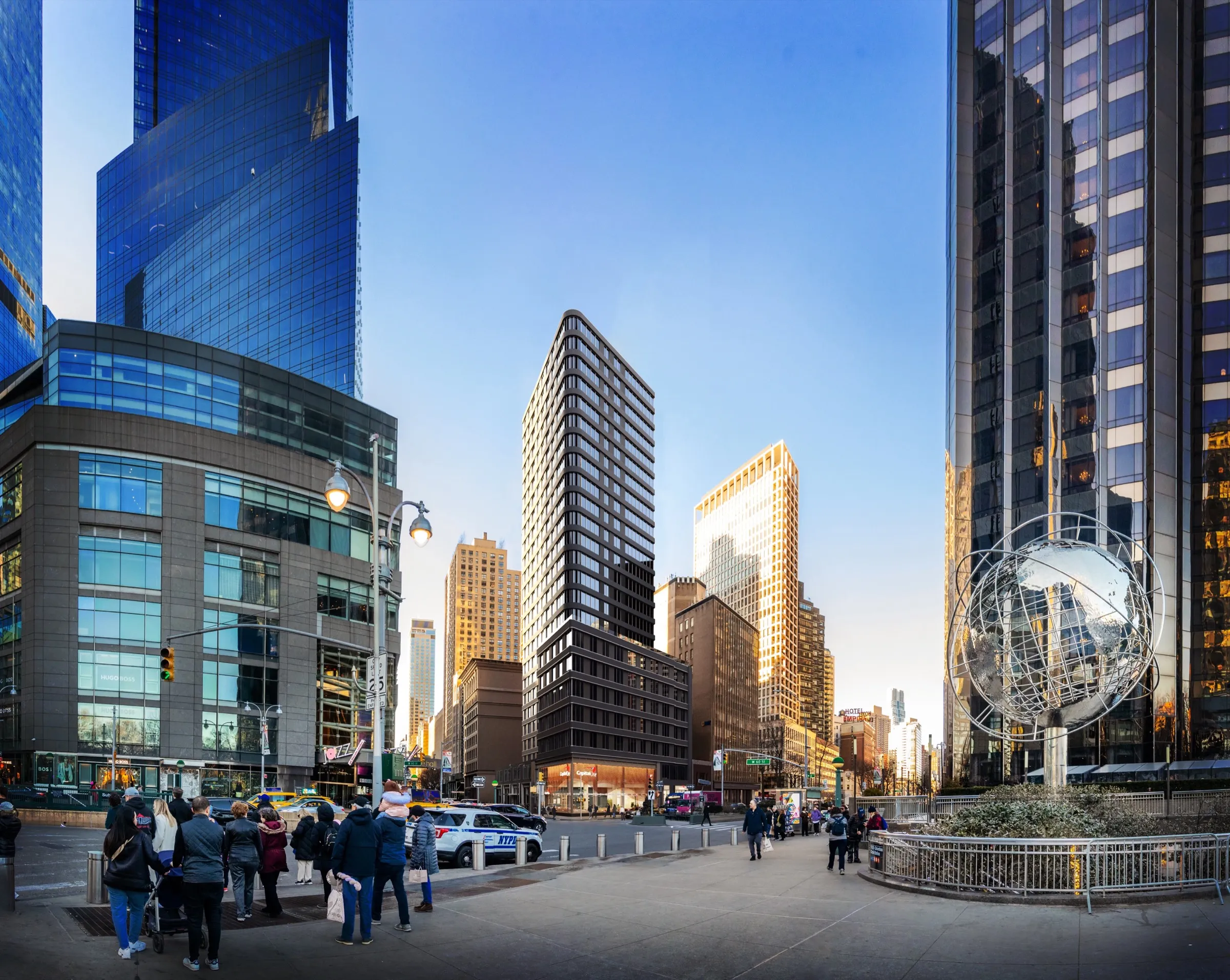
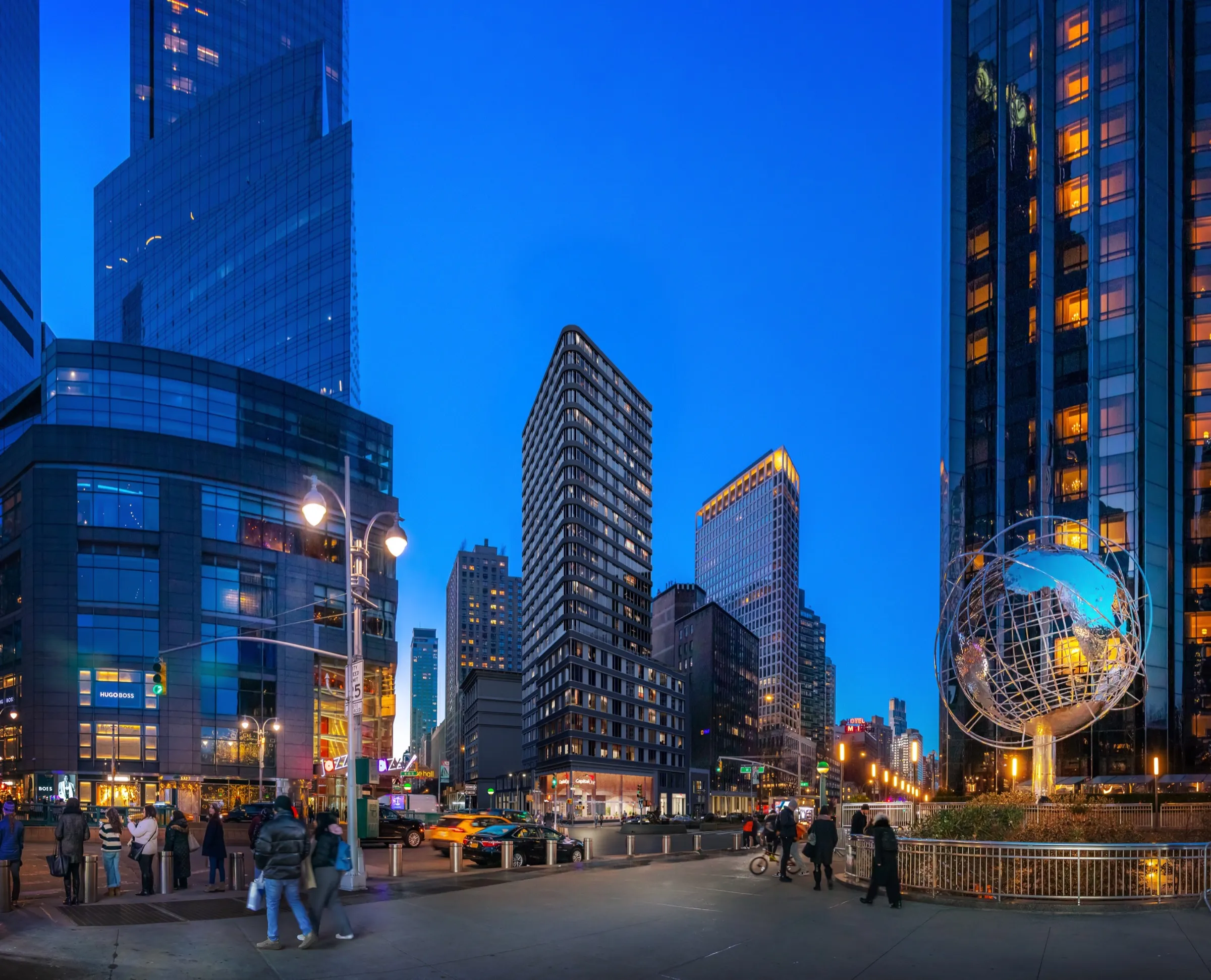
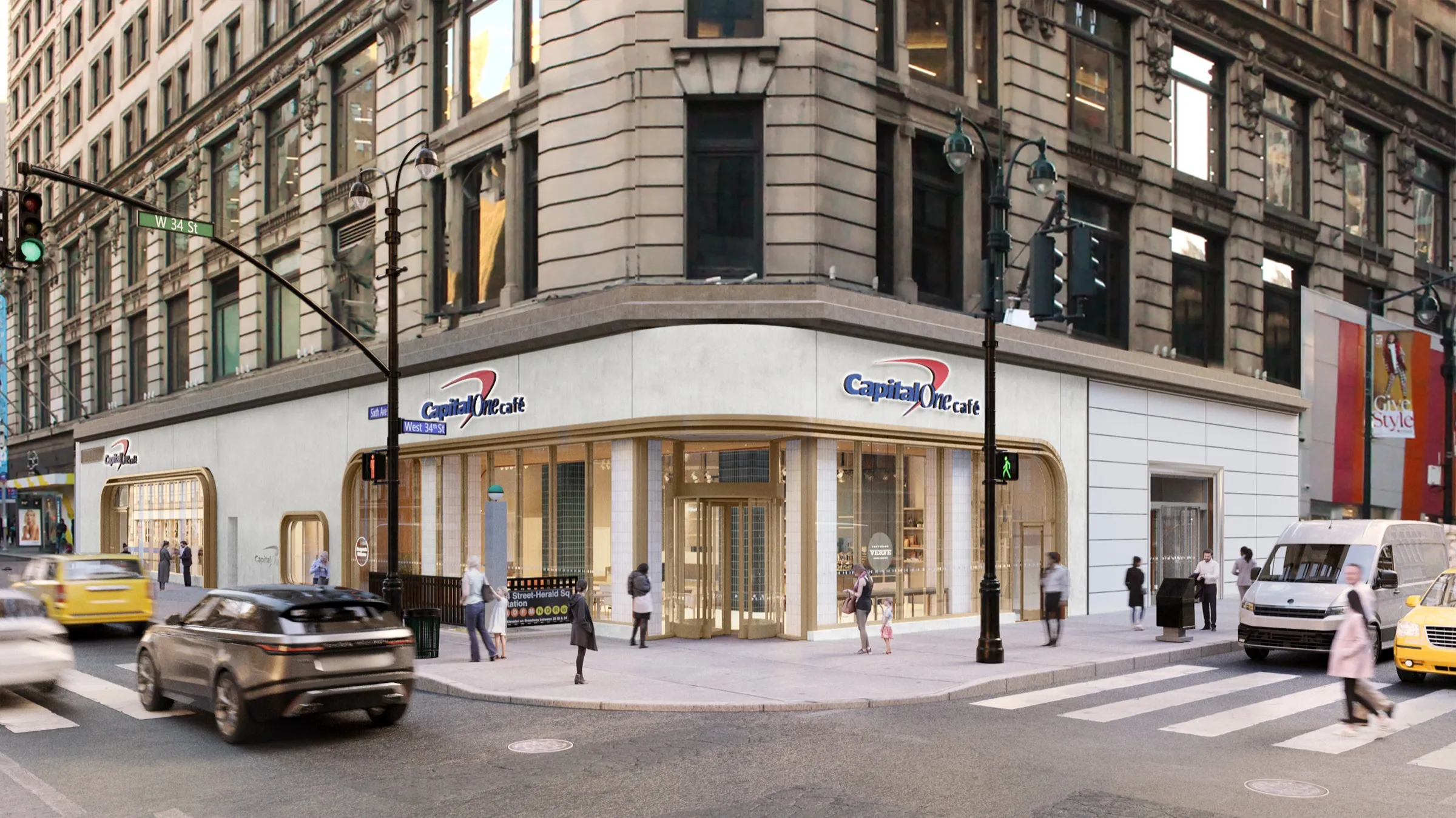
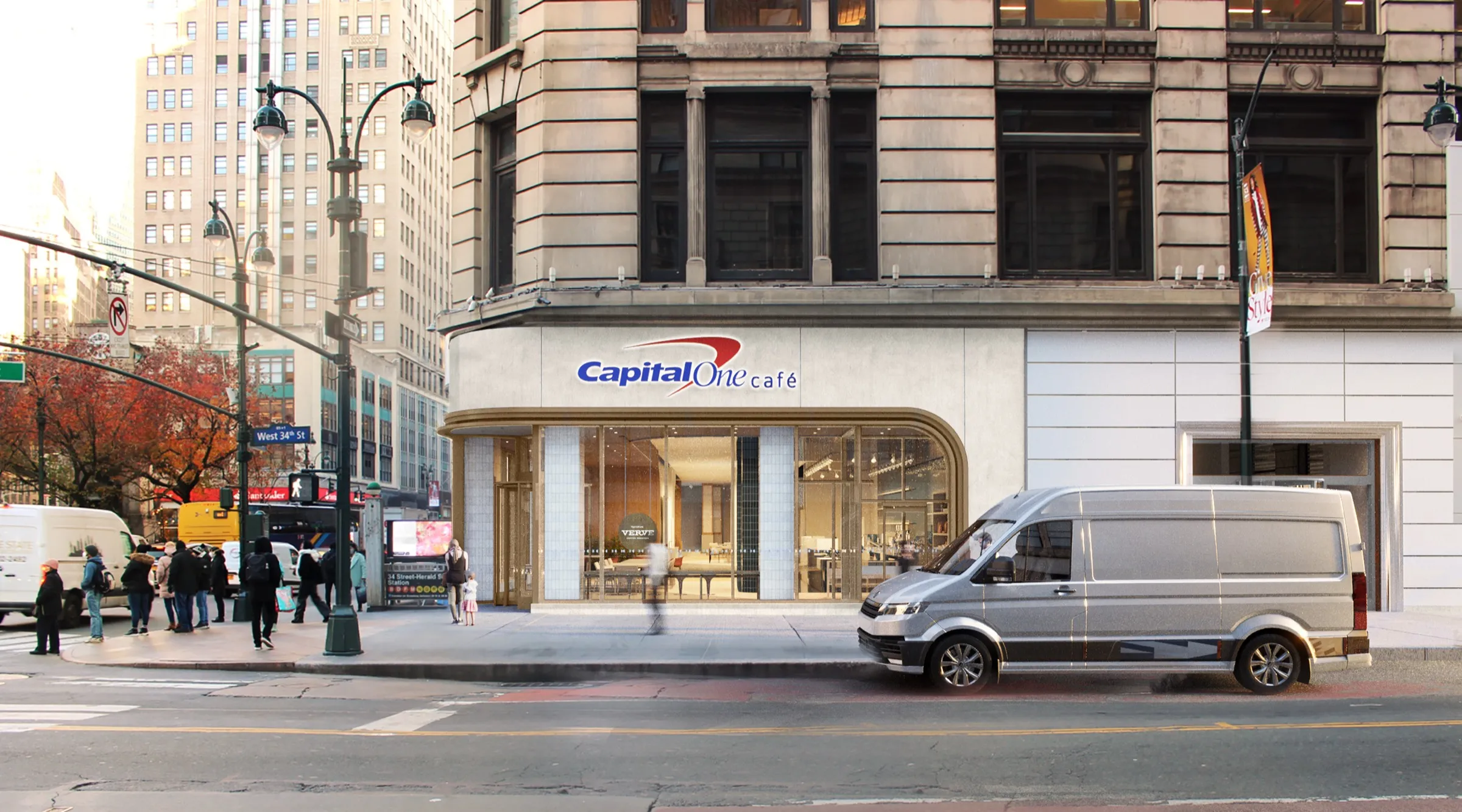
Rather than fabricate the surroundings, we grounded each exterior in the real street. For Herald Square, the OLA team photographed the site against a shooting guideline we supplied. For Columbus Circle, we commissioned a professional New York photographer, with OLA's executive architect approving the engagement, to capture the block at the angles our cameras used. We then built and composited the architecture into those real backgrounds, matching the 3D work to the surrounding facades and proportions, with realistic lighting, material behavior, and credible pedestrian life. Where the live street was too cluttered with cars and signage to read cleanly, we modeled those portions of the surroundings instead, keeping each view accurate without losing presentation clarity.
Delivery ran on a controlled, multi-phase system built for consistency: a grayscale phase for geometry validation, camera lock-in, and lighting structure; a color phase for materials, branding integration, and retail atmosphere; organized revision cycles aligned with OLA's review schedule; and final deck production formatted for Capital One's design and executive teams. On the most time-sensitive location, Herald Square, we moved straight to color previews to hold the review date.
This structured but flexible workflow allowed us to scale output while maintaining quality and keeping the project firmly on schedule.
The outcome
Built as Rendered, Open Across Manhattan.
"I love working with NoTriangle! I have worked with other rendering consultants, and none have been as easy to work with as NoTriangle. The images they have produced for us have been beautiful, and they go above and beyond with their responsiveness and communication. I would 10/10 recommend them and will continue to use them for all future projects."
Camille Bernsten, Assistant Project Manager, O'Neil Langan Architects
The visualization work directly supported approvals and smoother decision-making. Clear, brand-aligned visuals allowed Capital One's leadership to evaluate proposals with confidence, reducing friction and shortening review cycles, and the presentation quality rose well above the original materials OLA had been working from. The reliability of the workflow is what led OLA to expand the scope mid-project and continue the collaboration across additional locations, a visualization partner rather than a one-off vendor.
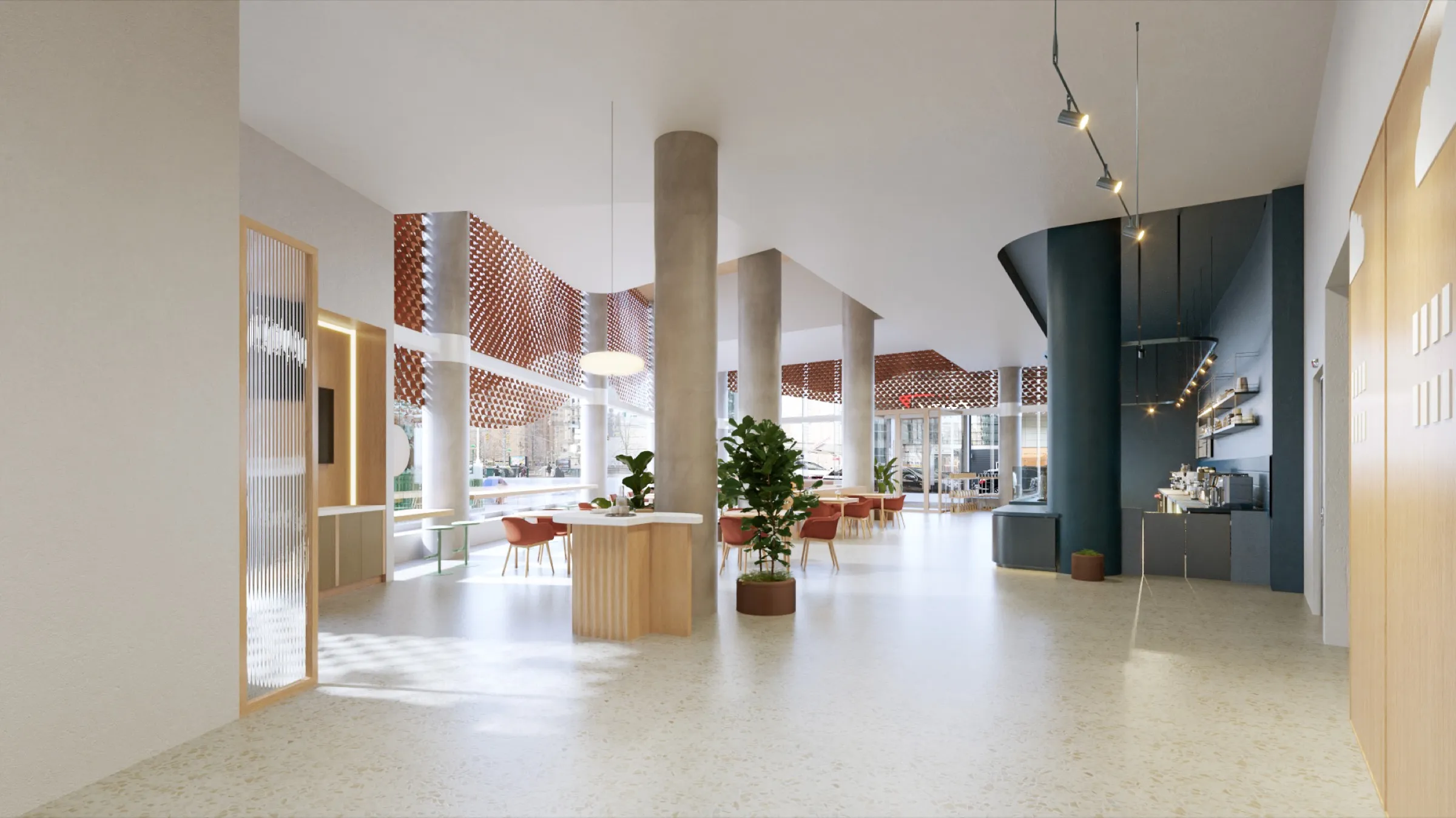
Most importantly, the cafés progressed from approval to construction and opening with a high degree of fidelity to the visuals. The built interiors carried the same material palette the renderings were held to, the cement-plaster storefronts, the deep Symphony Blue running through the space, the accent columns in Blue Ridge tile, and the terrazzo coffee bar, confirming that the renderings functioned not only as presentation tools but as accurate references for execution.
As of September 2026, all three locations are open and trading: Herald Square at 53 West 34th Street, Union Square at 853 Broadway, and Columbus Circle at 1843 Broadway, where the café held its grand opening in February 2025 as one of Capital One's flagship New York sites.
Questions
Retail Visualization and Design Approvals
- How do renderings help non-technical executives approve a design?
- For the Capital One Café locations, O'Neil Langan Architects needed sign-off from Capital One's leadership against fixed approval milestones. We acted as a visualization extension of their design team, turning Revit models and early-stage PDFs into brand-aligned views that non-technical stakeholders could evaluate at a glance. Clear, accurate visuals let leadership decide with confidence, which kept review cycles focused and the project on schedule.
- How do you make a retail storefront read accurately in its real city context?
- We ground each exterior in the real street rather than fabricate it. For the Capital One Cafés we worked from on-site photography, shot by the OLA team at Herald Square and by a professional photographer we commissioned at Columbus Circle, then built and composited the architecture into those backgrounds. Where the live street was too cluttered with cars and signage to read cleanly, we modeled those portions of the surroundings instead, so each prime Manhattan corner stayed accurate without losing presentation clarity.
- What goes into a multi-location retail visualization package?
- The Capital One Café work scaled from a single café to a multi-location package of 15 interior views and 8 exterior views across three Manhattan sites, delivered inside a fixed approval schedule. The count is set to cover the spaces and storefronts that drive an approval decision, not to picture every corner of every location.
- Can you tailor renderings to a company's brand standards?
- Yes, and on branded retail work the brand team holds real authority. On the Capital One Café renderings, brand decisions ran on the client's clock: one storefront update was held until Capital One's branding team selected the final vinyl pattern, with 48 hours' notice to jump back in, and view options were chosen down to whether the conference room wall carried the Capital One logo or stayed all glass. Working inside those standards, the signage, the Symphony Blue, the material palette, is what made the images decision-ready for executive review.
Services on this project
Related projects
Start with a discovery call
Every project starts with a conversation. The call is where we understand the project and whether we're the right studio to do the work.