 Skip to content

Case Study: Architectural Visualization Canada — Muse, Guildford Surrey
Strategic Visualization for a 108-Unit Development in Surrey, BC
Trusted by MLA Canada × and West Fraser Developments
When MLA Canada, one of Western Canada’s most established real estate sales and marketing firms, engaged NoTriangle Studio, the brief extended beyond producing attractive imagery.
Representing West Fraser Developments, MLA was preparing the pre-sale launch of a 108-unit residential community in Surrey’s Guildford neighbourhood—a highly competitive market where early buyer confidence, clarity of positioning, and perceived value play a decisive role in launch performance.
In this context, architectural visualization was not a finishing layer. It was a core sales and communication tool—used to support pricing, absorption, and brand perception from day one.
Project Context & Objective
The primary objective was clear:
support strong pre-sales momentum in the initial launch phase.
Beyond transactional outcomes, the project was positioned as a reputation-defining development for the client—meaning the visuals needed to perform consistently across sales, marketing, and long-term brand use.
Each asset had to be:
Market-ready from first release
Aligned with Guildford buyer expectations and pricing strategy
Distinct from competing Surrey developments
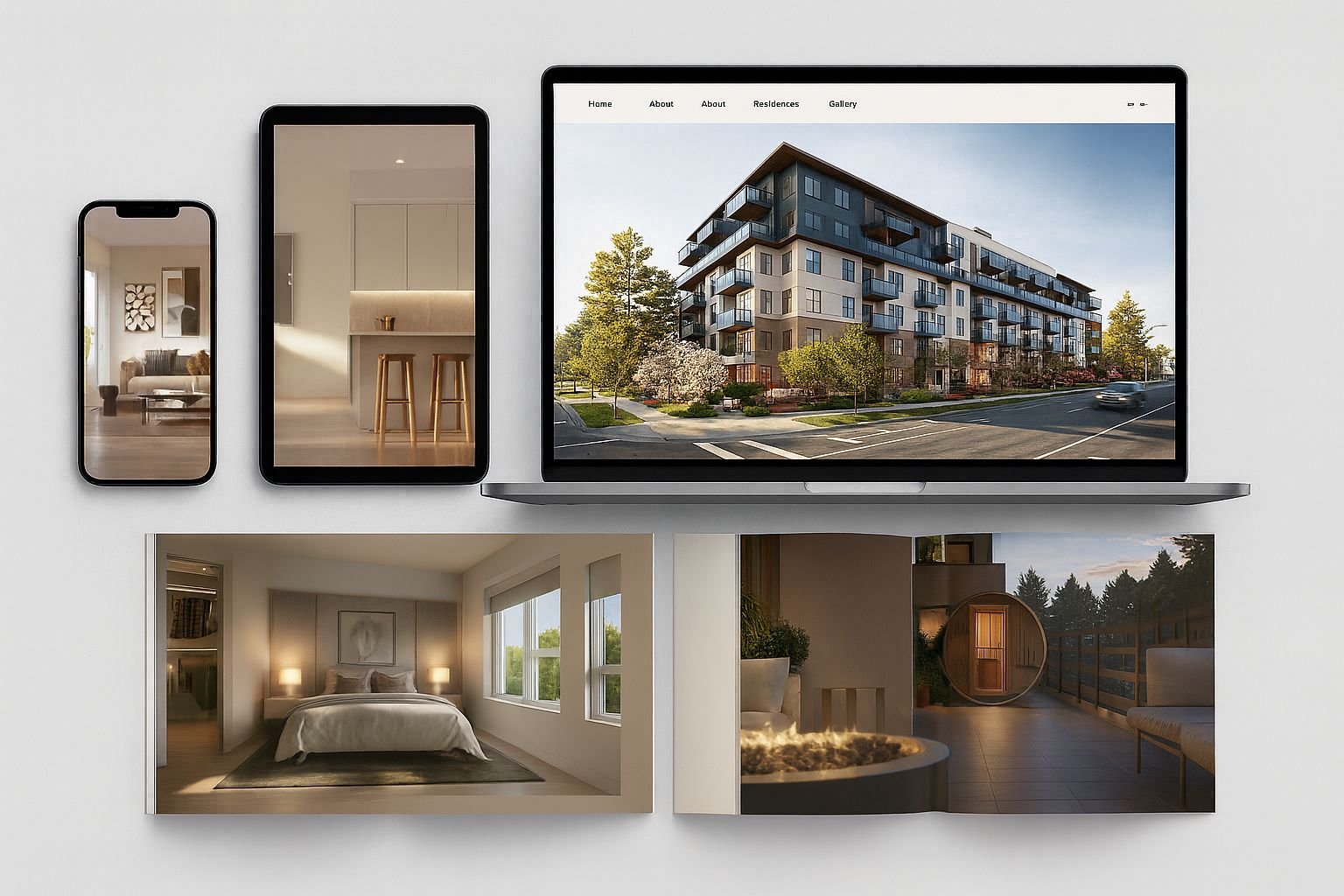
Flexible enough for use across print, digital, sales centres, and advertising
This is a common reality across architectural visualization in Canada, where visuals must satisfy both emotional appeal and commercial scrutiny.
Visualization Strategy
Rather than treating the work as a direct translation of drawings, NoTriangle approached the project with a marketing-first visualization strategy, shaped by audience, market context, and usage scenarios.
Working closely with MLA, we focused on:
Buyer personas including first-time buyers, young families, downsizers, and investors
Competitive analysis of comparable Guildford Surrey developments
Defining a visual tone that balanced accessibility with perceived quality
These inputs guided every decision—from camera selection and lighting direction to material emphasis and lifestyle cues—ensuring the imagery communicated value clearly and immediately.
The result was a cohesive visualization system designed not simply to look refined, but to build confidence, reduce buyer friction, and support early engagement.

Timeline & Delivery Realities
The project ran from February to September, spanning approximately seven months.
The extended timeline reflected real-world development conditions rather than production inefficiency, including:
- Multi-layered internal reviews across marketing, design, and leadership teams
Scope expansion from 12 to 16 images, plus an Animation Lite package
Coordination and timing of drone photography
Additional refinement cycles ahead of animation production
High-resolution 24” / 300dpi print outputs for sales collateral
Despite this complexity, milestones remained consistent. Clear communication and structured project management allowed momentum to be maintained even through extensive revisions and evolving inputs.
Once final imagery was approved, the animation phase progressed efficiently and without delay.

Managing Change & Iteration
Even with a strong initial brief, the project evolved through multiple layers of refinement—typical for developments preparing for the market.
Changes included:
Repositioning people within key amenity scenes
Adjusting lifestyle pacing and content within the animation
Refining kitchen and bedroom layouts following updated design feedback
Re-sequencing camera order to improve narrative flow
Introducing title cards to strengthen storytelling continuity
To support this, we applied a flexible revision framework, extending select updates beyond contractual limits to maintain cohesion and ensure the final output reflected the client’s evolving direction.

Clarifying Design & Technical Inputs
Although MLA supplied an unusually comprehensive material package—including interior specifications, FF&E schedules, brand guidelines, and camera references—several details required clarification as production progressed.
These included:
Minor discrepancies between plans and intended use
Mid-production model updates affecting exterior views
Confirmation of materials, finishes, and construction details
Replacement or custom modeling of unavailable furniture assets
The quality of the client’s documentation allowed these clarifications to be resolved efficiently, keeping production aligned without disrupting schedule or consistency.

Selecting and Refining Hero Views
The client arrived with preferred camera references. Our role was not to replace them—but to elevate their impact.
We refined hero angles by:
Strengthening visual hierarchy and composition
Adjusting camera height for natural residential perspectives
Using foreground framing to increase depth and realism
Prioritizing views that communicated livability and spatial flow
Each hero shot was selected to answer a specific buyer question—helping viewers understand the development quickly and confidently.

Color, Mood & Atmosphere
While interior palettes and furniture selections were defined, our contribution focused on translating specifications into emotional experience.
The visual direction centred on:
Aspirational warmth – clean, bright lighting with subtle warmth to convey comfort and desirability
Modern sophistication – balanced neutrals, tactile materials, and controlled contrast
Consistency at scale – a unified visual language across all deliverables
This ensured that the full set of renderings functioned as a single, coherent brand narrative.
Positioning the Development as “Modern + Aspirational”
To align with the client’s market goals, we applied a series of targeted artistic decisions:
Curated FF&E styling to avoid a staged or generic feel
Premium lighting behaviour using controlled reflections and depth
Lifestyle integration aligned with MLA’s marketing language
Cinematic camera movement within the Animation Lite package
The aim was to present the project not simply as a building—but as a lifestyle buyers could immediately imagine themselves stepping into.

Deliverables
The final visualization package included:
6 amenity renderings
1 aerial rendering
4K print-ready masters
Optimized assets for web, MLS, social media, and advertising
This set became the foundation of MLA’s entire pre-sales and marketing rollout.
Results & Usage
The visuals were deployed across:
Sales centre environments
Brochures and A-kits
Project website
Digital advertising campaigns
MLS and listing platforms
Social media and outdoor advertising
Because the imagery was aligned with buyer expectations, competitive context, and MLA’s sales strategy, it functioned as a core pre-sales asset—supporting differentiation, perceived value, and early interest at launch.

Client Feedback
“Working with the NoTriangle team has been a pleasure. They were very easy to work with and delivered a great final product.”
— Surjan Pahal, Marketing Manager, MLA Canada
Conclusion
This project demonstrates how a strategic 3D rendering company can support early-stage market performance when architectural visualization is grounded in clear objectives, audience insight, and disciplined collaboration.
By aligning visual output with buyer psychology, competitive positioning, and real sales usage—and by managing complex inputs through a structured workflow—NoTriangle Studio delivered a visualization package that strengthened launch readiness and elevated the project’s market perception.
For developers seeking architectural visualization in Canada, including 3D rendering services in Victoria BC and Western Canadian markets, this project reflects how visuals can operate not as decoration, but as a practical tool for approvals, investor communication, and pre-sales execution.